Obtain naturalization-related documents for your ancestors who emigrated from Italy.
THE KEY TO QUALIFYING for Italian citizenship Jure Sanguinis is to prove that the ancestor you are applying through did not become a US citizen before the next person in your line of ascendants reached adulthood, or that they never became a US citizen at all.
Proving Someone Naturalized in the United States
1. There are 3 sources of naturalization records in the US: (a) NARA, which has only naturalizations from federal courts, mainly between 1906 and sometimes in the 1950s. (b) USCIS, which is part of Homeland Security, used to be called INS, and was established in 1906. They have records of most naturalizations after 1905 including recent ones. (c) County courts and local archives of records from county courts, scattered throughout the county, which have records from before 1906 and include naturalizations from after then that did not take place in federal court. If you have access to it, you can also use an original certificate of naturalization that was issued to your LIRA who naturalized. Bring the original to show to the consulate along with a photocopy to leave with them for your file.
2. You definitely need either a certificate of naturalization (sometimes called a certificate of citizenship) or an oath of allegiance. These are the only official documents that actually state that someone has naturalized. If you have an original copy, take it and a photocopy with you to your appointment. The consulate will examine the original and only take the photocopy for your file.

3. The oath does not contain enough info to be used by itself, so it always must be accompanied by either a petition for naturalization (sometimes called a petition for citizenship) or a declaration of intent. We’ve actually only seen one case where someone used a declaration and oath without the petition, a long time ago, so I can’t promise that this will work now.
4. The certificate of naturalization is usually acceptable by itself, but not always. This is because it often lacks identifying information such as an exact date of birth (instead of just an age). For this reason, if you present only a certificate of naturalization, you may get asked to submit a petition as well. And if you get asked for the petition, then you may get asked for the oath, too, which is usually on the back of the petition, because if they’re not sure that the certificate is really for your ancestor then they’ll also need proof of naturalization and a petition without an oath does not constitute such proof. Of course, if you already have the petition and oath then you didn’t need the certificate in the first place.

5. An original certificate of naturalization is much more likely to be accepted by itself than a certificate of naturalization from some other source, such as USCIS or a county court. This is because if someone has an original certificate, then in all likelihood it belonged to a relative. On the other hand, anyone can obtain documents from USCIS, so a certificate from them is more likely to be for a person who just happens to have a name that is similar to your relative’s.
6. When one submits documents from a source (USCIS, NARA, etc.), you will often be asked to submit all documents from them, even though all of them wouldn’t have been necessary if they weren’t available. For uncertified documents you are more likely to be asked for a cover letter or the envelope they came in, too.
7. Consulates generally like to see certified documents. Those from NARA are certified, and often county court ones are, too, although recently we’ve seen more local archives refusing to certify documents. USCIS documents were certified a long time ago, but now are not, although it is still possible to get a Federal apostille on USCIS documents for use overseas. Consulates differ in their requirements for certification; some will require that naturalization documents have an apostille.
8. NARA documents, so long as they include the petition and oath, are properly certified, and do not contain “major” discrepancies, may be accepted as sufficient by themselves, though some consulates in the US also require a copy of the certificate of naturalization that can only be obtained from USCIS (unless you happen to have your ancestor’s original that you can bring to your appointment to show them and leave a copy of).
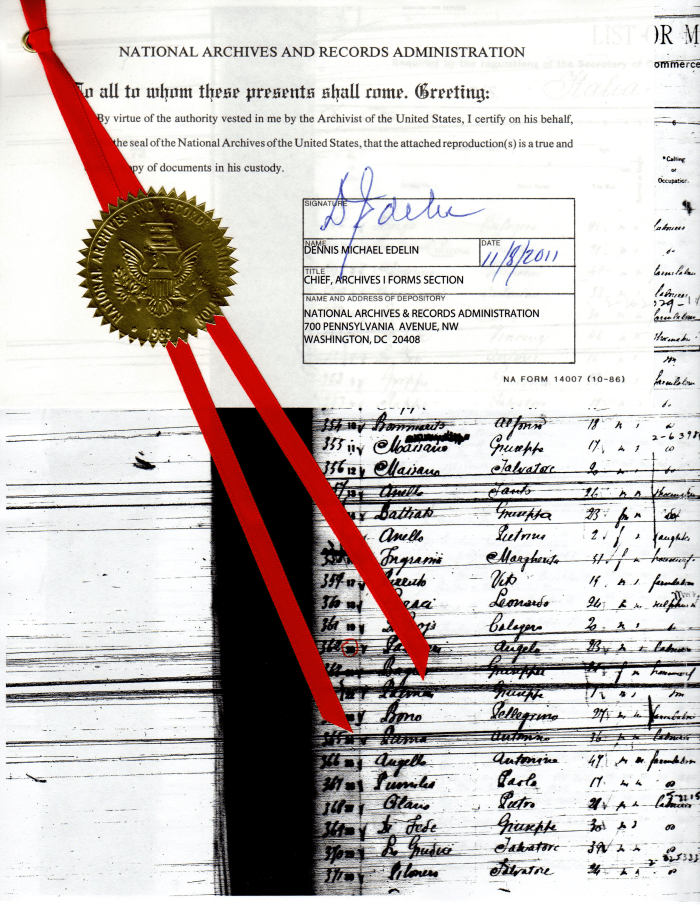
9. County court documents are often the best – they tend to include both the certificate of naturalization and the petition/oath, as well as other documents such as a certificate of arrival; they usually can be certified; they tend to be better quality copies than those from USCIS; and they usually contain a cover letter. The problem with these documents are that they can be hard to find, since there is no centralized source for them, and it may be hard to get the archives/county to certify them. Still, especially for naturalizations before 1906, they may be your only source for the naturalization documents.
10. Note that the sources mentioned in the last 2 items (NARA and county courts) do not necessarily overlap. You may be able to find documents at one or the other or both. And sometimes neither, since some documents that were held at county courts have been transferred to USCIS and now can only be found there.
11. Some naturalization records, including those for more recent naturalizations, are only available from USCIS. USCIS records are uncertified (although with some difficulty can be), so they are not accepted by themselves at some consulates, such as SF. Even some consulates, namely, NY and Chicago, that will usually accept USCIS records by themselves will sometimes ask to see other records, too, because the USCIS records are uncertified, often of poor quality, and have some identifying info blacked out.
Proving that Someone Did Not Naturalize
What if you cannot find any record of your ancestor’s naturalization?
You then must provide “proof” that he didn’t. For US consulates, to prove no naturalization, you need a lot whereas to prove naturalization you need much less. So, you will need the following under all name and birth date variations for your ancestor:

- USCIS certificate of non-existence of naturalization (known as a “CONE” or “CNE” in the forum.)
- To receive a Certification of Non-Existence of a Naturalization Record, fill out and send in form G-1566.
- No Record letter from the relevant National Archives NARA) branch
- You ask them to do a search and then put in writing that they found nothing.
- No Record letter from the local county courthouse where your ancestor lived.
- Certified census from NARA showing both your ancestor and next in the line of descent on it so the first one available after the next in the line of ascent became an adult. They want to see your ancestor listed as an “alien” (notated by “Al”) or as “first papers” (notated by “Pa”).
- Note that census records after 1950 do not contain citizenship status. Instead, you should rely on an alien registration explained below. Should your consulate still insist on a census after 1950, you have to go through the census bureau and request an “age search”. If your ancestor cannot be found on the census, a negative search result from the census bureau may suffice. Also note that a census incorrectly stating your ancestor naturalized is not, in itself, grounds for denial of your request, particularly if you have all the other information indicating otherwise. You might be asked for additional documentation, though.
- Optional (depending on the consular officer) but useful to have as supporting evidence.
- You may also need to present an A-File (“alien file”) if your ancestor was alive during the 40’s. (You can get this from the USCIS.)
- If you have access to them, it’s nice to show your ancestor’s old Italian passport and their copy of an American green card (if applicable) as they had to have a right to live here as a non-citizen if they never naturalized.
 Dual U.S. Italian Citizenship